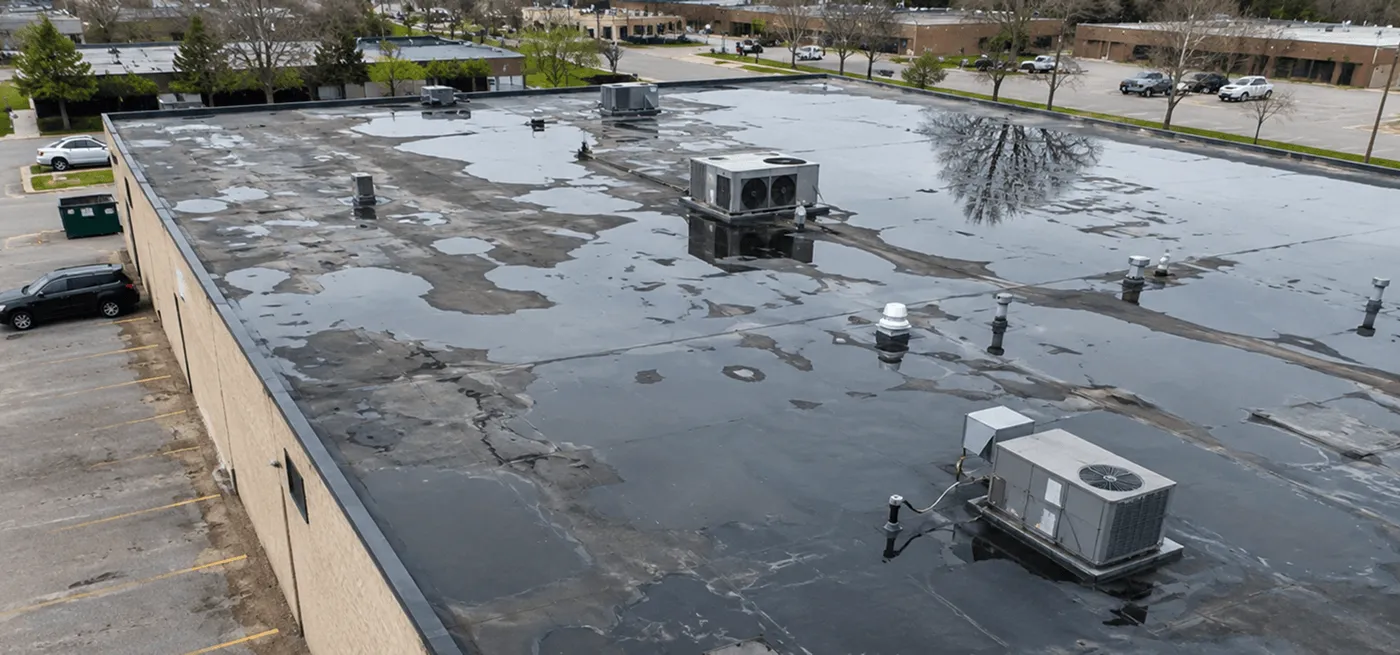

If you are dealing with flat roof leaks in Temple, the short answer is this: most start at ponding water, failed seams, or clogged drains, not from a single dramatic storm. On many commercial roof inspections across Temple, we trace flat roof leaks in Temple back to slow, unnoticed drainage problems that built up over several humid summer weeks.
Quick Answer: What Usually Causes Flat Roof Leaks in Temple?
Flat roof leaks in Temple usually start at one of three places: standing water that sits too long after a storm, a membrane seam that has separated from age or heat cycling, or a drain that's partially clogged with debris. Central Texas summers combine intense heat with sudden, heavy rain, and that combination stresses flat roofing membranes more than steady weather would. A commercial roof inspection can usually pinpoint the source within an hour or two, since leaks almost always trace back to one of these three causes rather than a mystery spot on the roof.
What Temple Business Owners Usually Notice First
Most business owners don't notice flat roof leaks in Temple until there's a stain on a ceiling tile or a drip during a heavy rain event. By the time water reaches the ceiling, it has often traveled several feet from the actual leak point on the roof above, which makes the source harder to pinpoint without getting up on the roof itself.
Some owners notice a musty smell near an HVAC unit or storage area before they see any visible water. Others only find out after a tenant or employee mentions a soft spot in the ceiling tile grid. These early signs are worth acting on quickly, since flat roof leaks in Temple tend to spread across a wider area underneath the membrane before they ever show up as a visible drip.
What a Roofing Contractor Looks For
On many commercial roof inspections we start at the drains and scuppers, since clogged or undersized drainage is one of the most common reasons flat roof leaks in Temple develop in the first place. A roofer evaluates this by checking whether water is draining fully within 24 to 48 hours after rain, since standing water that lingers longer than that puts steady pressure on seams and membranes over time.
From there, we walk the seams, looking for lifted edges, cracking, or areas where the membrane has pulled away from flashing at walls, curbs, or rooftop equipment. TPO and PVC seams are heat-welded and tend to fail at specific stress points, while EPDM seams rely on adhesive that can degrade with age and UV exposure. Knowing which membrane type is on the roof changes exactly where we look first.
We also check flashing around any rooftop penetrations, like HVAC curbs, vent stacks, and skylights, since these transition points see more movement and stress than the flat field of the roof. A roofer inspecting flat roof leaks in Temple pays close attention here, because flashing failures are often the actual entry point even when the visible damage shows up somewhere else on the ceiling below.
Common Mistakes and Misunderstandings
The biggest misunderstanding we run into is business owners assuming a small leak means a small problem. On a flat or low-slope roof, water can travel a significant distance under the membrane before it finds a path through the decking, so a drip in one corner of a building doesn't necessarily mean the leak is directly above it.
Another common mistake is patching a visible leak without addressing the underlying drainage issue. If ponding water caused the original failure, a spot repair without improving drainage often leads to a new leak nearby within a season or two. Flat roof leaks in Temple that get patched repeatedly without a drainage fix tend to become a recurring maintenance cost rather than a one-time repair.
We also see business owners wait too long to schedule an inspection after noticing a minor issue, hoping it resolves on its own between rain events. Flat membranes don't self-heal, and a small seam separation typically gets worse with each heat and rain cycle rather than staying the same size.
Decision Guidance: Repair, Recoat, or Replace?
If your flat roof leaks in Temple are limited to one or two identifiable spots, a targeted seam or flashing repair is usually the right first step, especially if the roof is less than 15 years old and otherwise in good condition. If drainage is the underlying issue, adding or enlarging drains may be necessary alongside the repair.
If your roof has multiple aging seams, widespread ponding, or is approaching the end of its expected service life, a reflective roof coating can extend its lifespan and improve drainage performance without a full replacement, provided the underlying membrane is still structurally sound.
If the roof is showing soft spots in the decking, widespread membrane failure, or has already required several repairs in the same areas, a full replacement is typically more cost-effective long-term than continuing to chase individual leaks across an aging system.
Local Weather and Material Context for Temple
Temple sits in a part of Central Texas where August brings both extreme heat and occasional bursts of tropical moisture pushing up from the Gulf, sometimes remnants of storms that made landfall days earlier. That combination is tough on flat roofing systems, since intense UV exposure dries and stresses membrane material while heavy, fast rainfall tests drainage capacity all at once.
Flat roof leaks in Temple often show up more in August and September than in spring, specifically because of this heat-then-rain pattern rather than a single major storm event. A membrane that handled a spring hailstorm without issue can still develop a seam failure months later from repeated summer heat cycling.
On a recent commercial roof assessment in Temple, a property manager called us after noticing water stains near a rooftop HVAC unit following a heavy August rain. The actual leak was tracked to a drain nearly 20 feet away that had been slowly clogging with debris over the summer, causing water to pond and eventually find a weak point in an old patch repair. Clearing the drain and properly repairing the seam resolved an issue that had been misdiagnosed as an HVAC condensation problem for weeks.
Request a Commercial Roof Assessment for Your Temple Property
Flat roof leaks in Temple rarely fix themselves, and the longer a slow leak goes unaddressed, the more likely it is to affect insulation, decking, or interior space below. A proper assessment traces the leak to its actual source instead of just patching the visible symptom.
Request a Commercial Roof Assessment from OSAAT, and we'll inspect the membrane, drainage, and flashing to identify exactly what's causing your flat roof leaks in Temple. We're a locally owned crew handling both residential and commercial roofing across Central Texas, so if you'd like to talk through your property in person, visit us in Killeen, TX.
Frequently Asked Questions
Why does my flat roof leak only during heavy rain and not light rain?
This usually points to a drainage or ponding issue rather than a membrane defect. Light rain drains before it accumulates, while heavy rain can overwhelm a partially clogged drain or exceed the roof’s slope capacity, causing water to sit long enough to find a weak seam or flashing point.
Can I just have someone patch the leak without a full inspection?
A patch can stop an active drip temporarily, but without identifying the underlying cause, whether that’s a drainage issue, seam failure, or flashing gap, the same flat roof leaks in Temple often return in a different spot within a season. A full inspection identifies the root cause, not just the visible symptom.
How long do TPO, EPDM, and PVC roofing membranes typically last before leaks become common?
Service life varies by manufacturer and installation quality, but most commercial membrane systems are rated for 15 to 20 years with proper maintenance. Leaks become more common as a membrane approaches the end of that range, especially around seams and flashing that have gone through repeated heat and UV cycling.
Should I file an insurance claim for a flat roof leak, or treat it as maintenance?
That depends on whether the damage traces back to a specific storm event or gradual wear, which is a coverage question your insurer or agent is better positioned to answer than a contractor. We can provide a documented inspection report of the roof’s current condition, which you can use to support that conversation, but we’re not able to advise on your specific policy or file the claim for you.
What’s the difference between a repair and a recoat for a flat commercial roof?
A repair addresses a specific failure point, like a seam or flashing detail, while a recoat applies a new reflective coating across the entire roof surface to extend its life and improve drainage performance. Recoating works best on membranes that are still structurally sound but showing age, rather than on roofs with widespread leaks or soft decking.
Want a straight answer on your roof? OSAAT gives free, documented roof inspections across Killeen and Central Texas, and we handle storm damage and the insurance claim with you.
Get a free estimate
Co-Owner, OSAAT Roofing & Construction.
Last updated August 28, 2026.